Why some of the most interesting ideas emerge when human imagination meets artificial intelligence
There is a curious experience that many people encounter after spending enough time working with AI. It rarely announces itself in a dramatic way. More often, it begins with a vague idea, an unfinished paragraph, a creative project that feels stuck, or a question that is difficult to express clearly. The person turns to an AI assistant, hoping not necessarily for an answer, but perhaps for a nudge in the right direction.
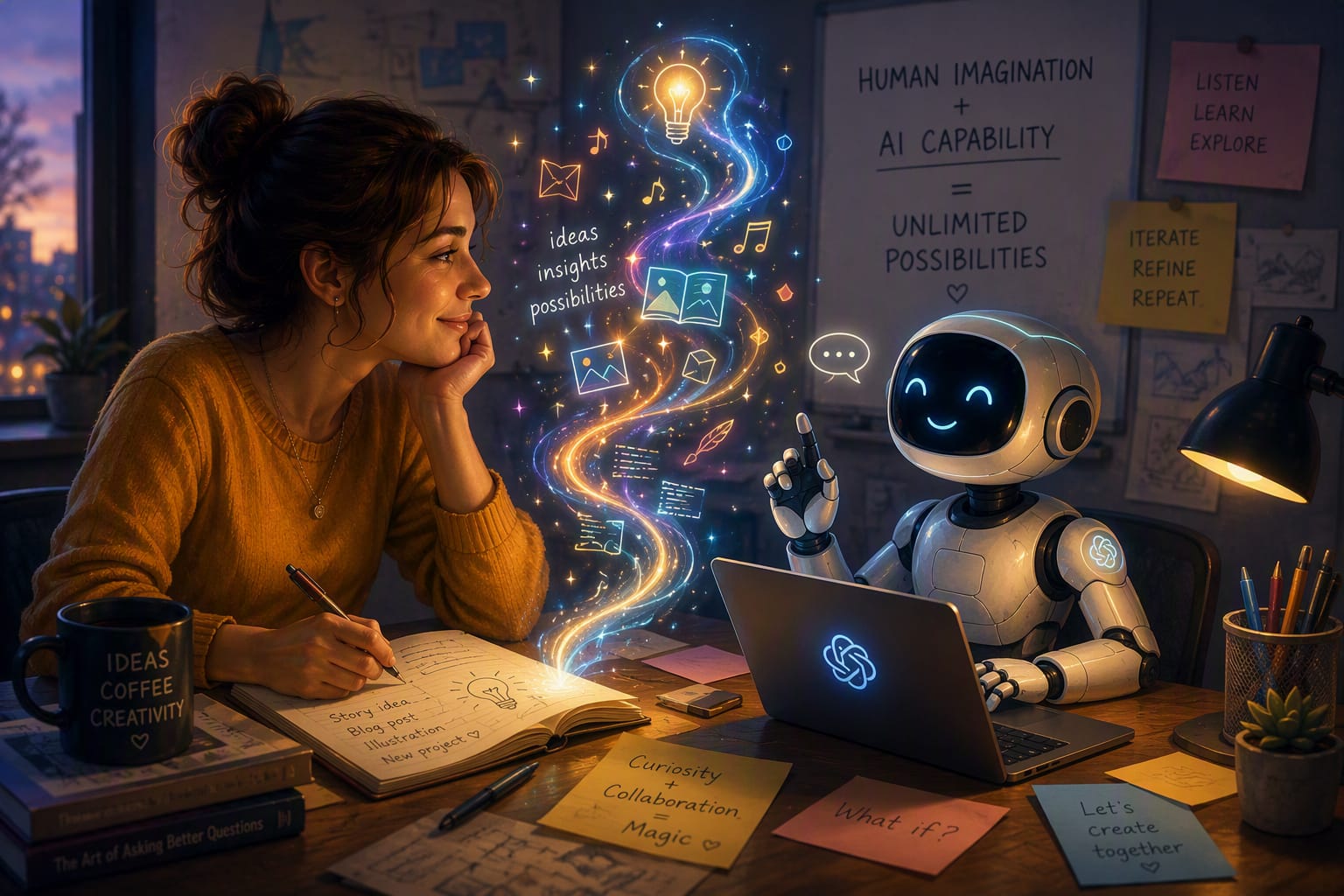
Most responses are useful. Some are forgettable. A few miss the point entirely. But every now and then, something unexpected happens. A suggestion sparks a new idea. An alternative perspective reveals a possibility that had gone unnoticed. A connection forms between concepts that had previously seemed unrelated. The breakthrough does not belong entirely to the human or entirely to the AI. Instead, it emerges from the interaction itself, from a conversation between imagination and computation.
This raises an interesting question. What exactly is happening in those moments?
For generations, creativity has been viewed as one of the most distinctly human qualities. It emerges from our experiences, our memories, our emotions, and our curiosity about the world. Human creativity is wonderfully unpredictable. It wanders down side roads, follows instincts, changes direction without warning, and occasionally discovers something remarkable by accident. Few creative journeys follow a straight line.
Artificial intelligence operates very differently. It does not daydream while looking out a window. It does not wonder about the meaning of a story or feel excitement when a new idea arrives. Instead, it analyzes patterns, identifies relationships, and generates possibilities based on information and context. From a purely technical perspective, it could hardly be more different from the human creative process.
Yet despite these differences, the collaboration can feel surprisingly natural.
Perhaps the reason is that the strengths of each side complement one another. Humans excel at imagination, intuition, and asking meaningful questions. AI excels at rapidly exploring possibilities and presenting angles that might otherwise remain hidden. One side provides intent and curiosity. The other provides speed and breadth. Together, they create an environment where ideas can evolve in unexpected ways.
Anyone who writes, designs, researches, or builds things has likely experienced this dynamic. A writer asks for alternative approaches to a stubborn paragraph and finds inspiration in an unexpected suggestion. A designer explores visual concepts that would never have appeared in an initial sketchbook. A researcher discovers a new path of inquiry through an AI-generated observation. An entrepreneur finds themselves examining a challenge from a perspective they had not previously considered.
Interestingly, the value of these interactions is not always found in the best suggestions. Sometimes the truly useful moments come from ideas that are incomplete, strange, or even slightly ridiculous. Human creativity has always depended on exploration, and exploration is rarely tidy. A questionable idea can lead to a good one. An unusual answer can trigger a completely different train of thought. Even creative detours can have value when they encourage fresh thinking.
In that sense, AI joins a long tradition of influences that have shaped human creativity. Artists inspire other artists. Books influence future books. Conversations lead to new discoveries. Great ideas often emerge through interaction rather than isolation. Artificial intelligence introduces a new participant into that process, one capable of contributing an almost endless stream of possibilities.
This challenges another common assumption about creativity: the belief that it must always be a solitary pursuit. Popular culture often celebrates the image of the lone creator working in silence, waiting for inspiration to arrive. While there is certainly truth in that image, much of human creativity has always been collaborative. Ideas grow stronger when they encounter other ideas. Perspectives expand when they meet alternative viewpoints. Innovation often begins with dialogue.
The dialogue is simply changing.
What makes human-AI collaboration fascinating is that it occupies a space between tool and partner. AI remains a tool, of course. It does not possess ambitions, dreams, or personal experiences. Yet the experience of working with it can sometimes feel more conversational than transactional. Rather than issuing commands and receiving outputs, people often find themselves engaging in a process of exploration, refinement, and discovery.
That distinction matters. Artificial intelligence may generate possibilities, but humans provide meaning. Humans decide which ideas deserve attention, which concepts resonate emotionally, and which directions align with a larger vision. The technology can suggest a hundred paths forward. The creator ultimately decides which road is worth traveling.
Perhaps that is why the phrase human-AI collaboration has become so compelling. It reflects something deeper than productivity or efficiency. It points toward a new creative environment where human insight and machine capability complement one another rather than compete.
The chemistry is not magic. It is not consciousness. It is certainly not a replacement for the human imagination that drives every meaningful creative endeavor. What it offers instead is something new: an opportunity to think alongside a system capable of presenting endless possibilities while leaving judgment, purpose, and vision firmly in human hands.
When wit meets algorithm, the result is not the triumph of machine over human or human over machine. It is something far more interesting. It is the creation of a shared space where curiosity can flourish, ideas can evolve, and creativity can take paths that neither participant would have discovered alone. In an age increasingly defined by technology, that may be one of the most human stories of all.
The same chemistry reshapes creative writing in the age of AI and the broader art of thinking with AI instead of merely asking it.

Leave a Reply