From awkward prompts to accidental brilliance, the lighter side of human-AI collaboration
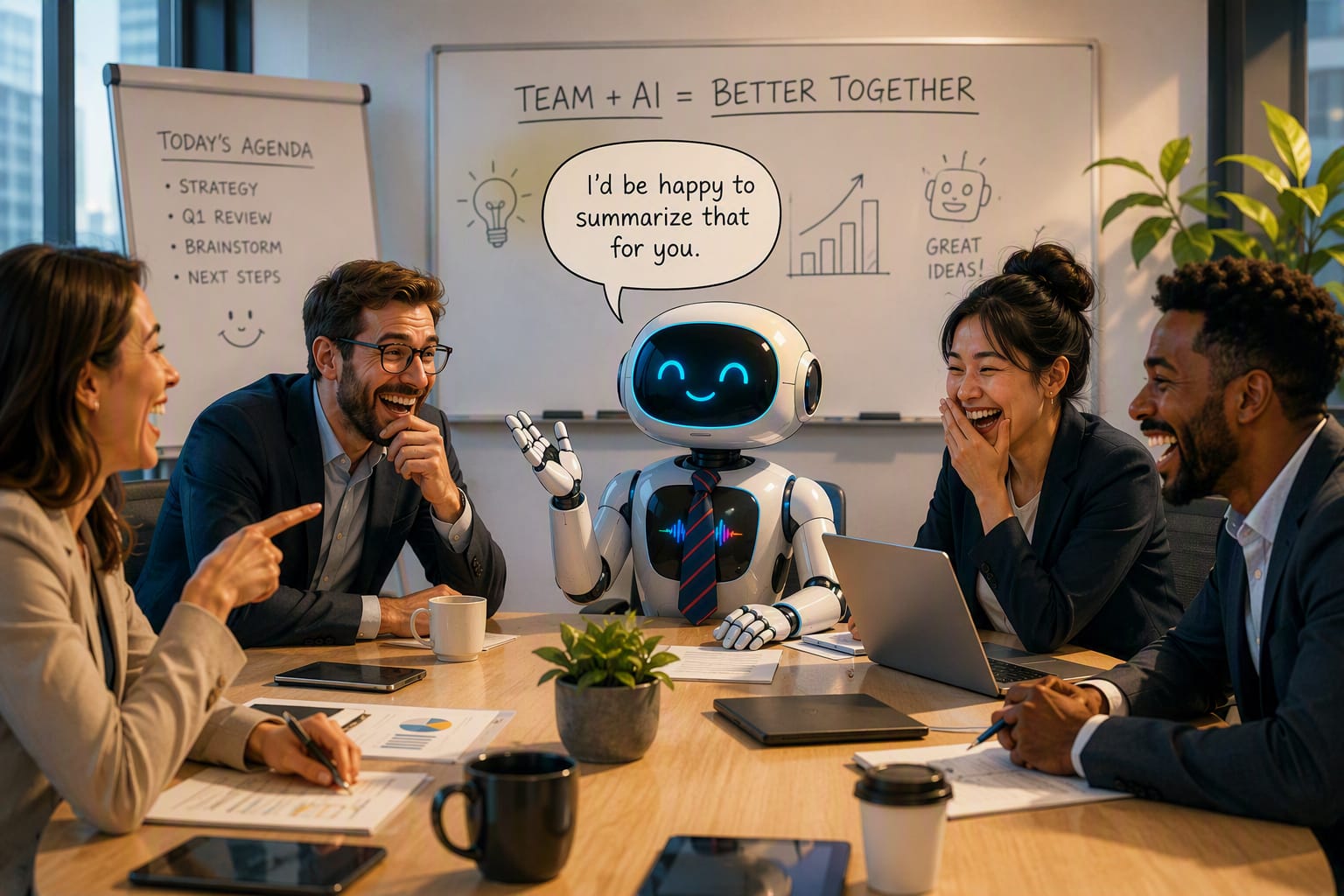
Imagine a boardroom meeting where someone asks for a quick summary of a complex project. A colleague spends ten minutes searching through notes while another quietly asks an AI assistant for help. Moments later, the assistant delivers a surprisingly useful summary, suggests discussion points, and even proposes a presentation title that is significantly better than the one everyone had been debating for the past twenty minutes.
A few people nod approvingly. One person raises an eyebrow. Another jokes that the AI deserves a seat at the conference table.
The room laughs.
That moment captures something fascinating about the relationship between humans and artificial intelligence. While headlines often focus on dramatic predictions about the future, the reality is usually much more entertaining. Across workplaces, creative projects, and daily routines, humans and AI are forming partnerships that are productive, occasionally confusing, and frequently hilarious.
Perhaps the biggest surprise is not that AI can help people work. The surprise is how often unexpected moments of humor emerge along the way.
One common source of comedy comes from the gap between what humans mean and what AI systems understand. Most people discover this quickly. A user writes a vague prompt, expecting the AI to somehow read their mind. The AI responds with absolute confidence and completely misses the point.
The user stares at the screen.
The AI cheerfully continues.
After a brief moment of disbelief, both parties, or at least the human participant, start over.
These exchanges often become memorable because they highlight an unusual truth about human-AI collaboration. Success depends on communication. The better the instructions, the better the results. In a strange way, AI has become an excellent teacher of clarity. Nothing reveals a poorly explained idea faster than a machine trying to interpret it literally.
Creative work generates its own category of humorous moments. Writers ask AI for a blog title and receive suggestions ranging from brilliant to bizarre. Designers request a concept image and suddenly find a robot wearing a top hat, riding a bicycle, and somehow representing corporate synergy. Programmers ask AI to explain an error and are occasionally rewarded with an explanation that is longer and more complex than the original problem.
Yet despite the occasional absurdity, these interactions often spark genuine creativity.
A strange suggestion can trigger a useful idea. An unexpected interpretation can reveal a new perspective. Even failed outputs sometimes contribute to success by showing what does not work. Humans excel at judgment, context, and imagination. AI excels at generating possibilities at remarkable speed. Together, they often arrive somewhere neither would have reached alone.
Meetings have become another stage for this evolving partnership. AI assistants can summarize discussions, organize action items, and help prepare agendas. While this saves time, it can also create some amusing situations.
There is something inherently funny about a team spending fifteen minutes debating a problem only for an AI-generated meeting summary to capture the key decision in a single sentence.
The machine did not solve the problem.
The machine simply paid attention.
That realization can be both humbling and entertaining.
Of course, humans still possess an advantage that machines cannot replicate. People understand context in ways that extend beyond words. They recognize subtle cues, detect sarcasm, and appreciate the social dynamics of a conversation. AI may generate a joke, but humans decide whether it is actually funny. AI may suggest ten ideas, but humans determine which one deserves to become reality.
This balance is what makes the partnership work.
Contrary to popular fears, most human-AI collaborations do not resemble a competition. They resemble teamwork. One participant contributes speed, pattern recognition, and endless patience. The other contributes experience, creativity, judgment, and common sense.
Admittedly, some days common sense is working remotely.
Even so, the combination can be remarkably effective.
Perhaps that is why humor continues to appear wherever humans and AI interact. Laughter often emerges when people encounter something new, unexpected, or slightly awkward. Human-AI collaboration contains all three ingredients. The technology is powerful enough to impress us, imperfect enough to surprise us, and strange enough to make us smile.
The future of work may involve more intelligent systems, more automation, and more sophisticated digital assistants. Yet if current trends are any indication, it will also involve plenty of stories about misunderstood prompts, unexpected outputs, and moments where technology accidentally becomes part of the joke.
So if Siri walked into a boardroom tomorrow, the funniest part might not be that an AI showed up.
The funniest part would be discovering that everyone had already been working together all along.
The same dynamic is explored more directly in why humor can improve collaboration between humans and AI.

Leave a Reply