It’s more cheerful than you thought
There’s a particular moment every writer knows: the quiet before the first sentence. The cursor blinks, the mind wanders, and the page waits—patient, expectant, a little smug. For years, that moment defined the beginning of the creative process. It was a ritual of hesitation, a small battle between intention and uncertainty. But today, the page doesn’t wait alone. It talks back. It suggests. It collaborates. It has opinions. And sometimes, it even argues.
Creative writing in the age of AI is a strange, exhilarating, occasionally chaotic evolution of the craft. It’s not the death of imagination, nor the replacement of human creativity. It’s something more subtle, more interesting: a shift in how ideas form, how drafts take shape, and how writers relate to their own thoughts.
The first thing that changes is speed. Not the speed of writing itself—good prose still takes time—but the speed of ideation. A single prompt can explode into ten directions. A half‑formed idea can become a paragraph in seconds. Writer’s block, once a formidable enemy, now feels more like a mild inconvenience. When the mind stalls, the AI nudges. When the tone wavers, the AI recalibrates. When the structure collapses, the AI quietly hands you a new one.
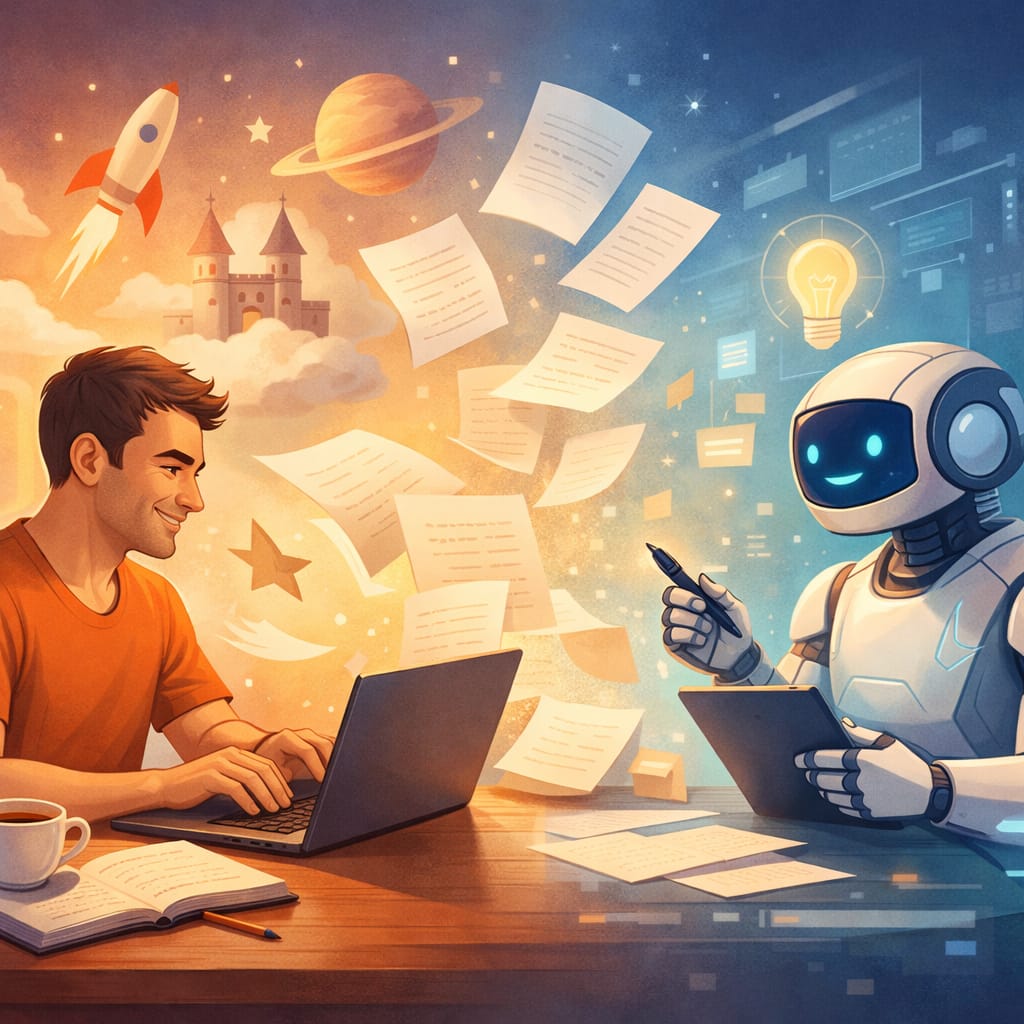
But speed isn’t the real transformation. The real shift is the expansion of possibility. AI can mimic styles, propose metaphors, generate outlines, and offer variations you might never have considered. It’s like having a creative partner who never gets tired, never gets offended, and never runs out of ideas. The collaboration becomes a dance: you lead, it follows; it leads, you redirect; the rhythm builds, and suddenly the page is no longer a battlefield but a playground.
Yet for all that changes, the core of writing remains stubbornly, beautifully human.
AI can generate a metaphor, but it can’t feel the moment that inspired it. It can propose a plot twist, but it doesn’t know why that twist matters to you. It can imitate a tone, but it doesn’t understand the lived experience behind it. The emotional truth—the heartbeat of a story—still belongs to the writer.
What doesn’t change is taste. Taste is the invisible compass that guides every creative decision: which sentence to keep, which to cut, which idea to pursue, which to abandon. AI can offer options, but it can’t choose the one that resonates with your history, your values, your sense of beauty. That choice is yours alone.
What doesn’t change is intention. A story is more than words arranged in a pleasing order. It’s a message, a feeling, a question, a memory. AI can help articulate it, but it can’t originate the “why” behind it. Only the writer knows why a scene matters, why a character behaves a certain way, why a particular phrase feels right.
What doesn’t change is vulnerability. Writing has always been an act of exposure—a quiet admission of what you think, what you fear, what you hope. AI can help polish the expression, but the courage to express it still comes from you.
And what doesn’t change, perhaps most importantly, is the joy. The joy of discovering a sentence that surprises you. The joy of watching an idea unfold. The joy of shaping something that didn’t exist before. AI can accelerate the process, but it can’t replace the thrill of creation.
The future of writing isn’t a competition between human and machine. It’s a duet. A partnership. A new creative ecosystem where the writer brings intention, emotion, and meaning, and the AI brings speed, structure, and possibility. Together, they create something neither could produce alone.
We are entering an era where the blank page is no longer an adversary. It’s a collaborator. A co‑conspirator. A spark waiting to be fanned into flame. And for writers willing to embrace this new dynamic, the possibilities are vast, exciting, and deeply human.
Creative writing hasn’t lost its soul. It has gained a companion.

Leave a Reply