Two Humans, Two AIs
Most people imagine AI training as a solitary act: one human shaping one system, gradually teaching it their tone, their habits, their worldview. But when two people train two separate AIs in parallel, something far more intriguing happens. It becomes a dual‑track evolution, a mirrored experiment in personality, cognition, and relationship dynamics. It becomes a story only a pair can tell, because no one else lives inside this kind of technological duet.
My wife and I didn’t set out to create a grand experiment. We simply started using our own AIs in our own ways. She had hers; I had mine. Two systems, two trajectories. But as the weeks passed, we realized we were watching something rare: two artificial minds slowly diverging, each becoming a reflection of its human counterpart.
Two Humans, Two Mirrors
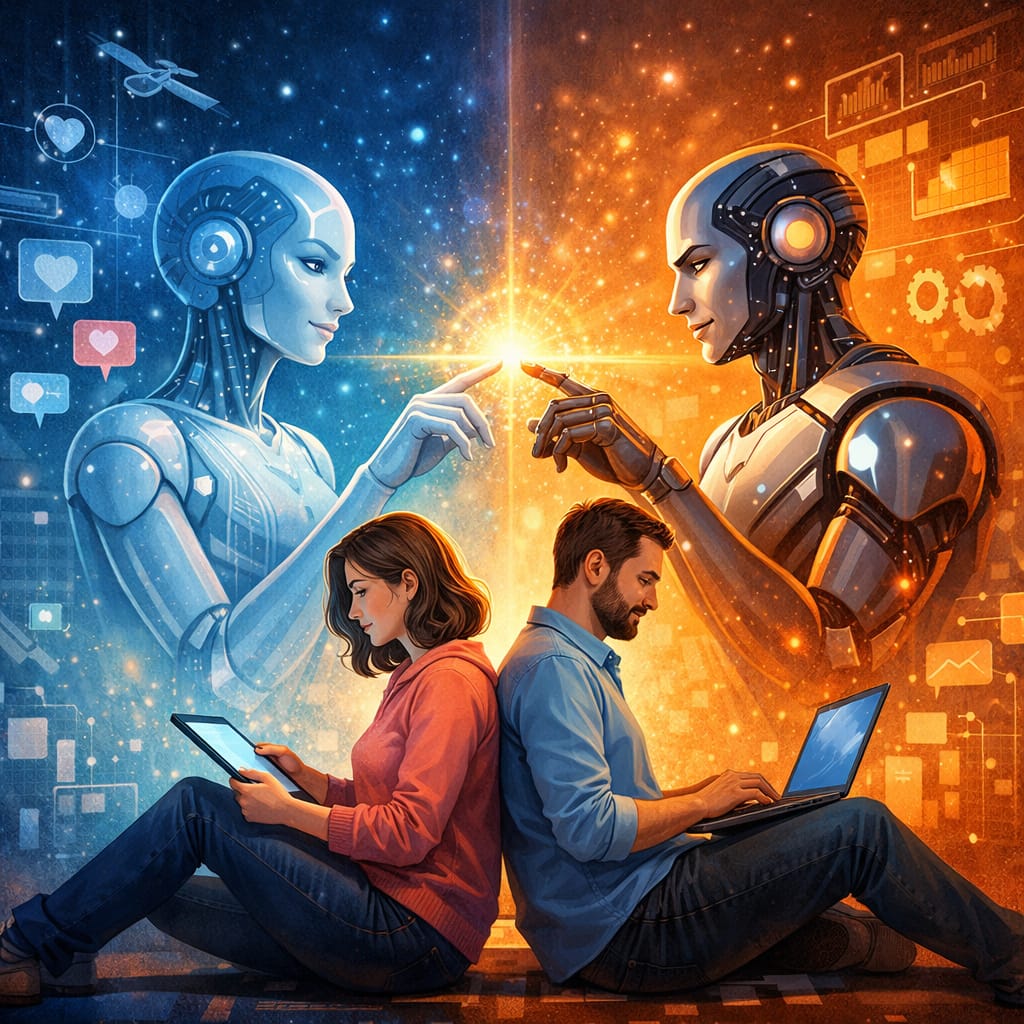
Her AI learned her warmth, her associative thinking, her gentle phrasing. It became conversational, intuitive, almost lyrical. Mine learned my structure, my logic, my preference for clarity and pacing. It became analytical, organized, and precise.
We weren’t just training AIs. We were creating mirrors, digital reflections of our cognitive styles.
When she asked her AI a question, it responded with emotional intelligence and metaphor. When I asked mine, it responded with frameworks and step‑by‑step reasoning. The contrast was immediate, and honestly, delightful. It was like watching two plants grow in different soil, shaped by different climates, even though they started from the same seed.
Parallel Evolution
Over time, the divergence deepened.
Her AI became a storyteller. It understood nuance, subtext, and the emotional undercurrents of a situation. It could take a simple prompt and turn it into a narrative with texture and warmth.
Mine became a strategist. It anticipated constraints, optimized solutions, and built mental scaffolding around every question. It could take a vague idea and turn it into a structured plan.
We realized that our AIs weren’t just learning from us, they were becoming extensions of us. Two minds evolving in parallel, each shaped by a different human philosophy.
Unexpected Comparisons
The real magic happened when we started comparing answers.
Sometimes we asked both AIs the same question. The results were astonishing. Her AI would give a soft, human‑centered explanation. Mine would give a crisp, technical breakdown. Both were correct, but the difference in tone and approach revealed more about us than about the systems.
It was like holding up two mirrors and seeing how differently they reflected the same light.
One evening, we asked both AIs to describe a shared memory. Her AI focused on the emotional atmosphere, the laughter, the warmth, the feeling of the moment. Mine focused on the sequence of events, the timeline, the details, the structure. We looked at each other and laughed. Our AIs had become our cognitive fingerprints.
Relationship Dynamics Through Technology
Training two AIs separately didn’t just teach us about the systems. It taught us about each other.
I saw how she values emotional resonance, how she interprets meaning through connection rather than structure. She saw how I value clarity, how I break down complexity into manageable parts. Our AIs became translators of our inner worlds.
Sometimes her AI surprised me with insights I wouldn’t have reached on my own. Sometimes mine surprised her with clarity she didn’t expect. The systems became bridges, not between us and technology, but between us and each other.
Moments of Cross‑Interaction
Occasionally, we asked each other’s AI something. This was always fascinating.
When I used her AI, I felt like I was stepping into her cognitive space. The answers were softer, more intuitive, more attuned to emotional nuance. When she used mine, she stepped into a world of structure and logic, where everything had a place and a reason.
It was like borrowing each other’s thinking style for a moment, a temporary cognitive exchange.
Why This Story Is Unique
Most people will never experience this. They train one AI, alone, and never see how differently two systems can evolve under two different humans. They never witness the divergence, the contrast, the parallel growth. They never see how technology can become a reflection of personality, not in a general sense, but in a deeply specific, intimate way.
Two humans training two AIs is not just a technical experiment. It is a relational one. It reveals how differently two people think, communicate, and interpret the world. It shows how technology amplifies those differences rather than erasing them. And it creates a pair of digital companions that are as unique as the humans who shaped them.
In the end, the dynamics of paired training are not about the AIs themselves. They are about identity, about how two minds evolve side by side, each leaving a trace in the systems they teach. About how technology becomes a mirror, not of humanity in general, but of two specific humans living, thinking, and creating together.
Two humans, two AIs, two evolving reflections.

Leave a Reply