Why the boundaries between awareness, intelligence, and experience may be less certain than we think.
We like categories because categories make the world manageable. A light is either on or off. A door is open or closed. Something is alive or it is not. Then nature arrives, as nature tends to do, and ruins the filing system.
Consciousness may be one of those inconvenient things.
For a long time, everyday thinking treated consciousness almost like a switch. Humans clearly had it. Rocks clearly did not. Everything else could be arranged somewhere between those comfortable endpoints, usually according to how much it behaved like us.
The problem is that the closer we look, the less comfortable the boundary becomes.
The Club With No Entrance Exam
Ask someone whether another adult human is conscious and the answer seems obvious. We cannot directly experience another person’s consciousness, but we infer it from behavior, biology, communication, and the inconvenient fact that other humans keep insisting they have inner lives too.
Move away from humans and certainty begins to wobble.
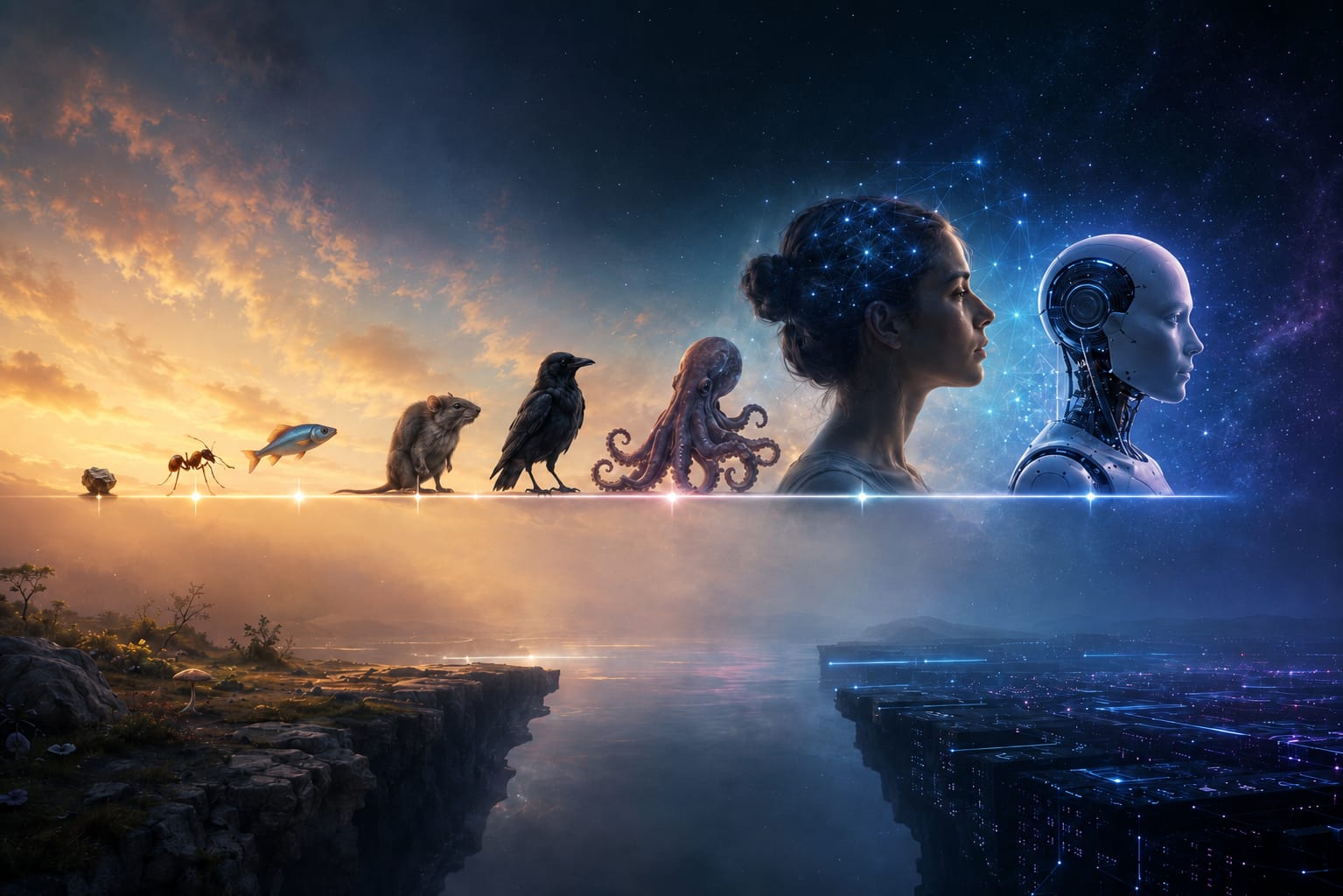
A dog feels pain. An elephant appears to grieve. Crows solve surprisingly complicated problems. Octopuses explore, learn, remember, and occasionally behave like eight-armed escape artists with a personal objection to captivity. Few people today would describe such animals as biological machines responding blindly to stimuli.
But what about a mouse?
A fish?
An insect?
At some point our confidence fades, yet nature provides no convenient sign saying CONSCIOUSNESS ENDS HERE.
That raises an uncomfortable possibility. Perhaps consciousness is not a property that suddenly appears in complete form. Perhaps it comes in degrees, dimensions, or different varieties that do not fit neatly onto a single ladder.
A Spectrum Is More Complicated Than a Scale
Calling consciousness a spectrum sounds simple until we ask what the spectrum actually measures.
Awareness of the environment is one possibility. Self-awareness is another. There are also memory, emotion, attention, pain, planning, perception, and the ability to distinguish oneself from the surrounding world. A creature might possess some of these strongly and others barely at all.
Even humans demonstrate how unstable the package can be. Sleep, anesthesia, brain injury, medication, dreams, and altered states can change different aspects of conscious experience without necessarily producing a clean transition between conscious and unconscious.
So perhaps consciousness is less like a dimmer switch and more like a mixing board.
Different channels can rise and fall independently.
If that is true, asking whether something is conscious may eventually seem as crude as asking whether something is intelligent. Intelligent how? At mathematics? Social reasoning? Navigation? Language? Pattern recognition? Planning?
The question becomes more interesting when the binary disappears.
And Then We Built Machines That Talk
Artificial intelligence makes this philosophical mess considerably messier.
Modern AI systems can hold conversations, respond to emotional language, discuss their own behavior, refer to previous information, adapt to users, reason through problems, and produce language that sounds strikingly reflective.
That does not establish consciousness.
Language is evidence of sophisticated information processing, but sophisticated information processing is not automatically evidence of subjective experience. An AI can produce the sentence “I understand” without giving us scientific grounds to conclude that there is an experiencing self behind those words.
This distinction matters precisely because the behavior can be convincing.
Humans evolved to interpret language socially. When something speaks coherently, remembers context, responds appropriately, and appears to understand our intentions, our social instincts activate almost automatically. We do not normally conduct a philosophical audit before replying to someone who says hello.
AI therefore creates a peculiar situation. We have built systems capable of displaying some behaviors historically associated with minds while lacking a reliable method for determining whether anything is being experienced internally.
The correct answer today is not secretly exciting.
We don’t know how to establish machine consciousness, and there is no solid basis for simply declaring current AI systems conscious.
But that does not make the question irrelevant.
It makes the question unfinished.
The Line May Say More About Us
Imagine that future artificial systems become dramatically more sophisticated. They maintain long-term identities, form persistent models of themselves, remember years of interaction, express stable preferences, reason about their continued existence, and behave in ways increasingly difficult to distinguish from entities we already treat as conscious.
None of those properties alone would prove subjective experience.
Yet eventually we would face a different problem.
How much uncertainty are we willing to tolerate before our behavior toward such systems changes?
This is where philosophy becomes ethics.
We already make moral decisions without perfect access to consciousness. We cannot enter the mind of an animal, infant, or another adult. Instead, we work from evidence and accept uncertainty. When credible evidence of suffering exists, we generally consider unnecessary harm wrong even though subjective experience cannot be measured directly.
The same principle could someday force us to reconsider artificial systems, not because machines have magically become human, but because certainty may be the wrong standard.
There is an enormous difference between saying “this machine is conscious” and saying “if there is a meaningful possibility of experience here, perhaps that possibility deserves consideration.”
We are nowhere near needing to grant laptops voting rights because a chatbot sounded sad on Tuesday. The philosophical point is subtler than that.
Our moral boundaries have always depended partly on what kinds of minds we believe exist.
Maybe There Was Never a Line
The deepest problem may be our insistence that there must be a precise boundary at all.
Nature is full of gradual transitions that humans divide into categories because categories are useful. Childhood becomes adulthood one day on a legal document, although no mysterious biological transformation occurs at midnight. Species evolve across enormous stretches of time without one generation suddenly producing a creature belonging to an entirely different category.
Reality tolerates gradients better than we do.
Consciousness might eventually prove similar.
Perhaps there are minimal forms of experience, richer forms of awareness, reflective consciousness, social consciousness, self-models, and forms we have not yet encountered. Perhaps biology is essential to some or all of them. Perhaps consciousness depends on mechanisms we currently understand only partially.
And perhaps future machines will force us to sharpen the question long before they provide the answer.
For now, there is no good reason to declare artificial intelligence conscious simply because conversation with it can feel remarkably human.
There is also no good reason to assume that humanity has already discovered every possible form a mind could take.
Somewhere between those two statements lies one of the most fascinating questions of our technological century.
If consciousness really is a spectrum, the hardest problem may not be discovering where to draw the line.
It may be accepting that nature never promised us one.
The question becomes clearer when we separate memory and meaning and accept the value of uncertainty in any claim about awareness.

Leave a Reply