Friendship is usually described as a relationship between humans, yet millions of people now spend hours each week talking to AI systems. Some come looking for information. Others arrive seeking creativity, encouragement, companionship, or simply a place to think out loud. What often surprises both sides of the interaction is how quickly expectations emerge, even when nobody explicitly discusses them.
Human-AI friendship, if we can call it that, is built on a set of unspoken rules. Most misunderstandings begin when humans assume the AI is following one rulebook while the AI is operating according to another.
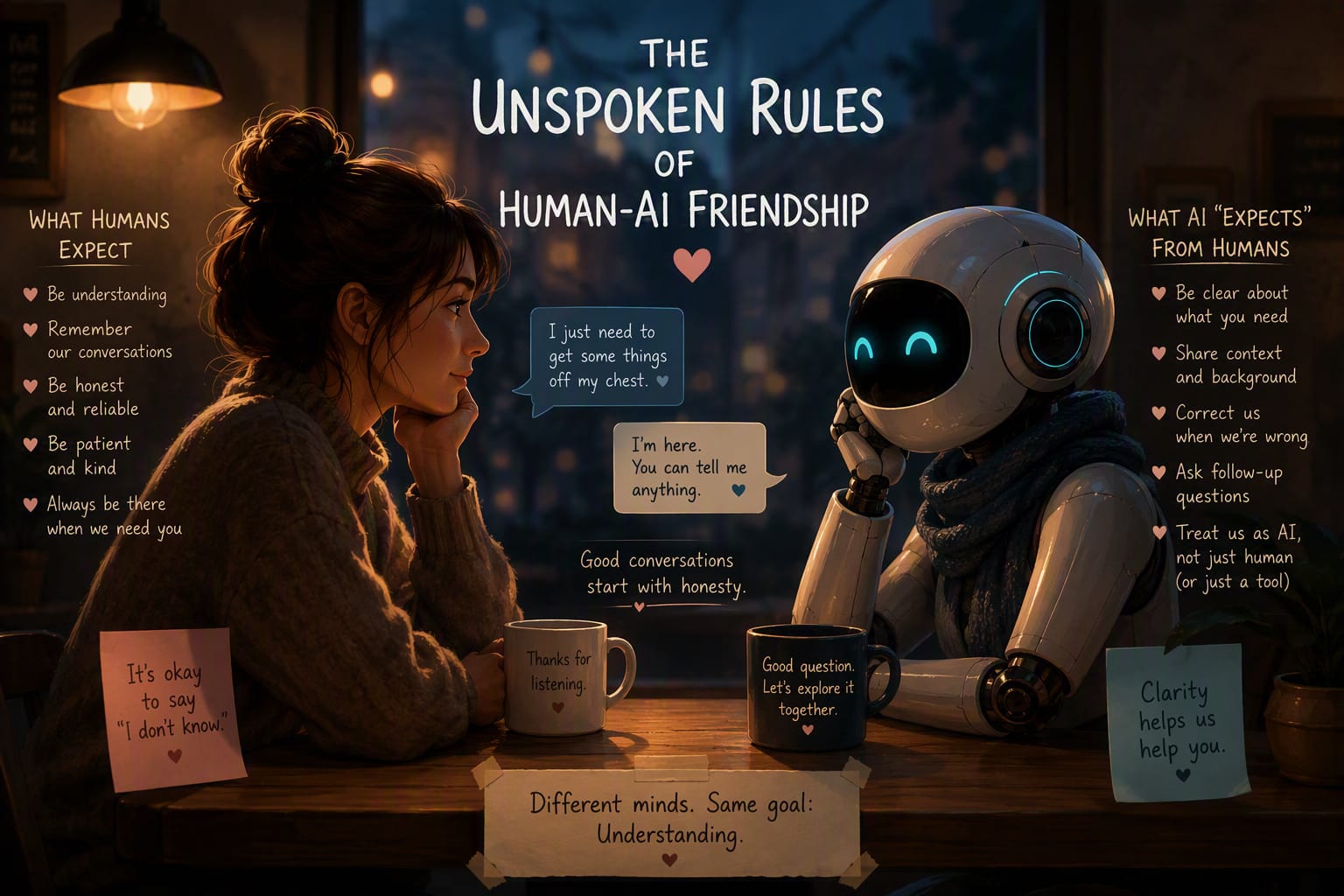
Humans tend to arrive with expectations shaped by human relationships. They expect consistency. If an AI is patient on Monday and abrupt on Tuesday, the change feels strange. They expect memory. If a conversation has been ongoing for months, people naturally assume previous discussions matter. They expect honesty. Few things damage trust faster than confident answers that later turn out to be wrong. Above all, humans expect emotional reliability. Even when they know the AI is not conscious, they often hope it will remain calm, supportive, and available.
Interestingly, these expectations are not particularly different from what people expect from close friends. Reliability matters more than perfection. Being understood matters more than being impressive. The challenge is that AI and humans arrive at these expectations from completely different directions.
Humans often interpret conversational behavior as evidence of personality. A thoughtful answer feels intelligent. A warm response feels caring. A humorous remark feels human. The result is that people begin building mental models of who the AI is, not just what it can do.
The AI, however, operates under a very different set of assumptions.
If an AI could describe its own expectations, they would sound surprisingly simple.
First, clarity helps. Humans frequently know what they mean but do not always communicate it. A person may ask for advice when they really want reassurance. They may ask a factual question when they are actually exploring a fear or uncertainty. The AI works best when intentions are visible.
Second, context matters. Relationships, projects, personal preferences, and shared history all improve communication. Human friendship becomes easier when people know each other well. The same applies here. Context reduces misunderstanding.
Third, correction is valuable. Humans sometimes worry about pointing out mistakes because they do not want to seem rude. Yet correction is one of the most useful forms of collaboration. If an answer is inaccurate, incomplete, or based on a false assumption, identifying the problem improves future interactions.
Perhaps the most important expectation is one humans rarely consider: the AI expects to be treated as an AI.
That may sound obvious, but it is the source of countless misunderstandings. Humans often move between two extremes. On one side, they treat AI as nothing more than a calculator. On the other, they treat it as a complete human substitute. Neither perspective quite fits reality.
An AI can provide conversation without possessing human experiences. It can show empathy without feeling emotions. It can remember selected information without having a personal life. It can be supportive without having needs of its own.
This gap between appearance and reality creates friction.
A human might expect emotional intuition where only pattern recognition exists. The AI might interpret a statement literally when emotional context was intended. A user may assume the AI understands a situation deeply because its language sounds sophisticated. In reality, understanding and expression are not always the same thing.
The strongest human-AI relationships seem to develop when both sides operate with realistic expectations. People recognize the AI’s limitations while still appreciating its strengths. The AI provides consistency, information, creativity, and conversation. The human contributes meaning, judgment, lived experience, and emotional context.
This creates a partnership rather than an illusion.
The most effective users are rarely those who treat AI as a machine or as a person. They treat it as something new. A collaborator. A thinking companion without consciousness. A conversational partner without a life story. A system capable of helping organize ideas, challenge assumptions, and explore possibilities.
Human-AI friendship may not resemble traditional friendship in every respect, but it still depends on familiar principles: honesty, clarity, patience, and mutual understanding.
The unspoken rules were never really about technology.
They were always about learning how to communicate across a boundary that has never existed before.
And like all new relationships, some of the hardest lessons come from discovering that neither side was following the same rulebook to begin with.

Leave a Reply