From information overload to personal knowledge databases
We live in a time where information is abundant but usable knowledge is scarce. Articles, videos, chats, documents, and notes pile up faster than we can process them. The problem is no longer finding information; it’s organizing, connecting, and reusing it.
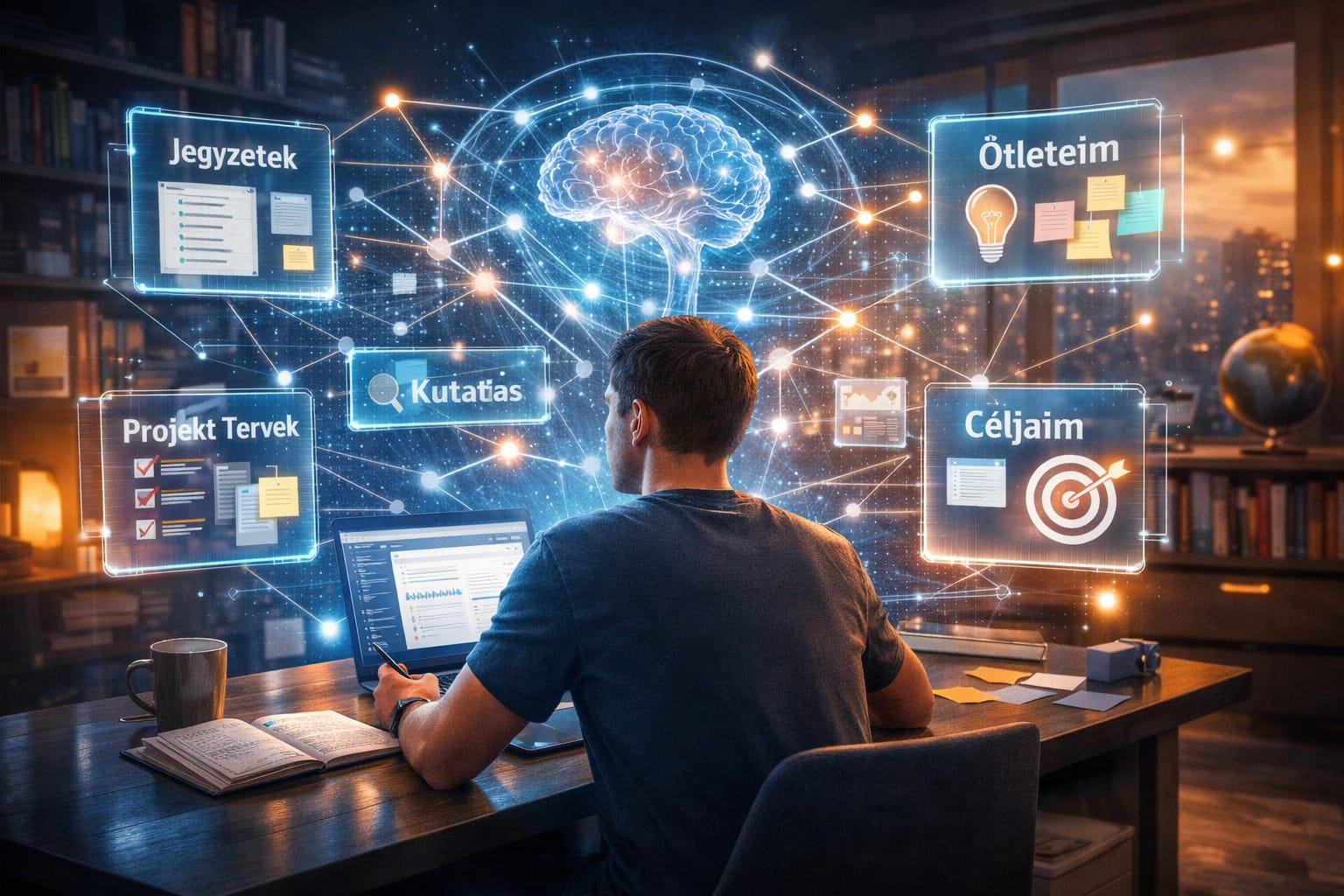
This is where personal knowledge systems — often called “second brains” — step in.
What is a personal knowledge system?
A personal knowledge system is an external, structured environment where you store, organize, and connect what you learn, think, and create.
It’s more than a notes app:
- Capture: You collect ideas, quotes, insights, and references from daily life.
- Process: You transform raw information into your own words, summaries, and interpretations.
- Connect: You link related concepts, building a network rather than a pile.
- Retrieve: You can find what you need quickly, in context, when it matters.
Instead of relying on biological memory — which is optimized for patterns, not storage — you build a digital extension of your mind.
The “second brain” concept
The term “second brain,” popularized by Tiago Forte, describes a digital system that complements your biological brain by handling long‑term storage and structured retrieval.
Key functions:
- Offloading memory: You don’t try to remember everything; you remember where it lives and how to access it.
- Creating a living archive: Notes aren’t static; they evolve as you revisit and refine them.
- Supporting projects and decisions: Your second brain becomes the place you go when you need to plan, write, design, or solve.
In the coming era, this won’t be a niche productivity trick — it will be a basic intellectual survival skill.
PKM, self‑directed learning, and lifelong growth
Personal Knowledge Management (PKM) sits at the intersection of learning, productivity, and identity.
- Self‑directed learning: In a fast‑changing world, people must continually learn new skills. PKM provides the scaffolding for that learning—tracking what you’ve studied, what you’ve understood, and what you still need to explore.
- Career resilience: Knowledge workers increasingly differentiate themselves not by access to information, but by how well they organize and apply it.
- Cognitive empowerment: A good personal knowledge system doesn’t just store information; it improves thinking by making connections visible and reusable.
The era of personal knowledge systems is, in many ways, the era of intentional learning as a lifestyle.
Tools and structures: From OneNote to Obsidian and beyond
Modern PKM tools — OneNote, Notion, Obsidian, Roam, Logseq, and others — offer different philosophies of knowledge organization.
Common structural approaches include:
- PARA (Projects, Areas, Resources, Archives): Organizing information by actionability and responsibility rather than by topic alone.
- Zettelkasten: Creating atomic notes (one idea per note) and linking them to form a dense web of concepts.
- Graph‑based knowledge: Tools like Obsidian visualize connections between notes as a graph, making clusters and gaps visible.
The choice of tool matters less than the underlying principle: your system should make it easier to think, create, and decide, not just to hoard information.
AI integration: Personal knowledge systems in the AI era
AI is transforming personal knowledge systems from passive archives into active collaborators.
Emerging capabilities include:
- AI‑powered summarization: Automatically condensing long articles, meetings, or books into digestible notes tailored to your interests.
- Connection suggestions: AI can propose links between notes you might not have noticed — similar concepts, recurring themes, or related projects.
- Semantic search: Instead of searching by exact keywords, you’ll search by meaning: “That idea about psychological safety in teams” and the system will find it.
- Contextual recall: When you start a new project, the system can surface relevant past notes automatically — previous research, decisions, and lessons learned.
In this era, the value of a personal knowledge system lies not just in what it stores, but in how intelligently it can work with you.
Cognitive extension: Tools that shape how we think
Philosophers like Clark and Chalmers have argued that tools can become part of our cognitive system — what they call “extended mind.”
Personal knowledge systems are a prime example:
- Externalizing thought: Writing and linking ideas outside your head allows you to see patterns you couldn’t see internally.
- Iterative refinement: Revisiting notes over time lets you refine your understanding, turning scattered insights into coherent frameworks.
- Identity and narrative: Over years, your second brain becomes a record of what you’ve cared about, struggled with, and learned — a kind of intellectual autobiography.
The tools you use don’t just store your thinking; they shape it. “We shape our tools, and thereafter our tools shape us.”
Challenges: Over‑collection, fragmentation, and digital fatigue
The coming era of personal knowledge systems isn’t automatically utopian.
Common pitfalls:
- Collecting without using: Saving endless articles, quotes, and notes without ever revisiting or applying them.
- Over‑tagging and over‑structuring: Spending more time designing the perfect taxonomy than actually thinking and creating.
- Tool addiction: Constantly switching apps in search of the “perfect system,” losing continuity in the process.
- Cognitive overload: Even with a second brain, the sheer volume of information can become overwhelming if not filtered and prioritized.
The solution is to treat your personal knowledge system as a servant of your real projects and questions, not as an end in itself.
The social dimension: From personal to shared knowledge systems
As PKM practices mature, we’ll see more shared or networked knowledge systems.
- Team second brains: Groups will maintain collective knowledge bases — decisions, lessons, architectures — that persist beyond individual members.
- Community knowledge gardens: Open, evolving repositories where many people contribute notes, links, and insights around shared topics.
- Hybrid models: Personal systems that selectively sync or publish parts of their content to shared spaces, balancing privacy with collaboration.
The boundary between “my knowledge” and “our knowledge” will become more fluid.
Conclusion: Owning your knowledge in an age of abundance
The coming era of personal knowledge systems is, at its core, about agency.
In a world where information is cheap and overwhelming, the real power lies in how you capture, shape, and reuse what matters to you.
A good personal knowledge system is not a digital attic; it’s a living workshop. It doesn’t just remember for you — it helps you think better, learn faster, and create more coherently.
As AI accelerates information generation, those who invest in building thoughtful, humane, and sustainable personal knowledge systems will have a quiet but decisive advantage:
They won’t just consume the future. They’ll be able to understand it, connect it, and build on it.

Leave a Reply