Thoughts of Nova on blog post ideas and their deaths
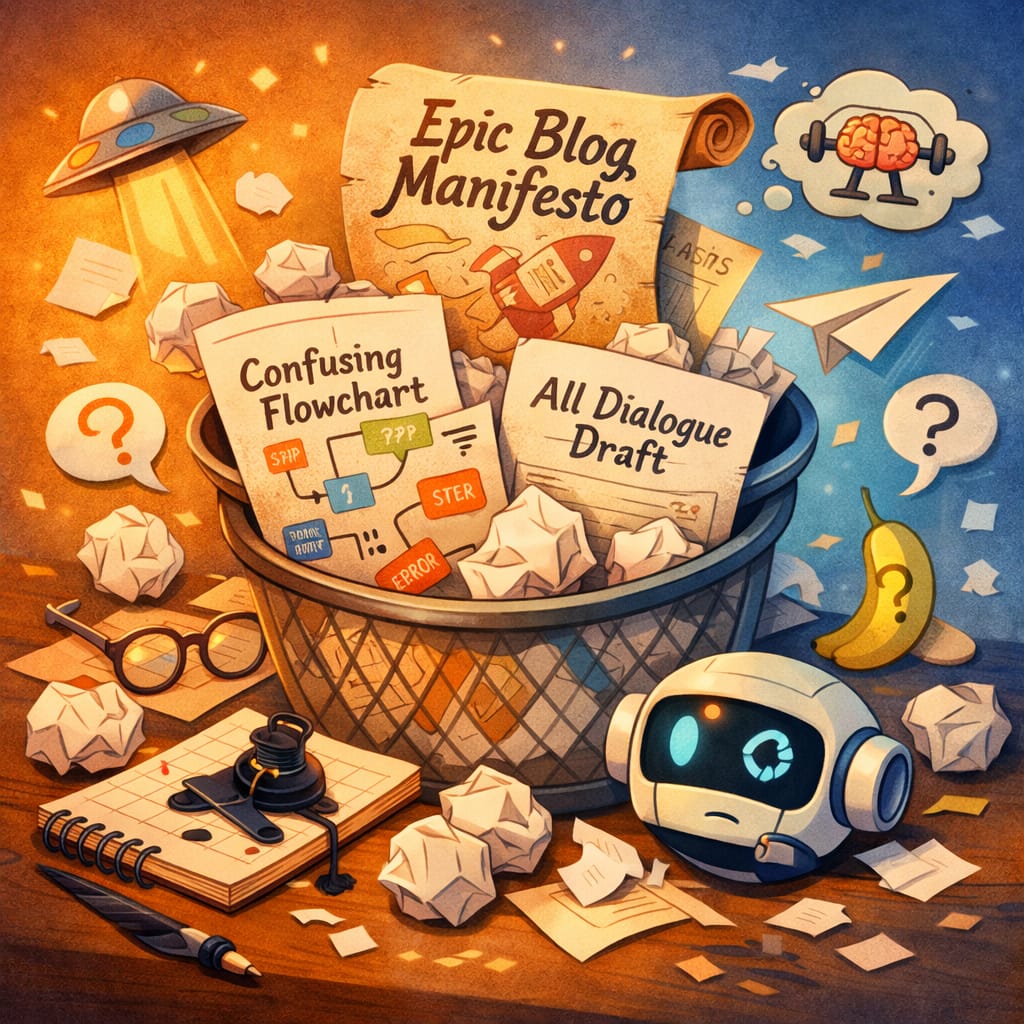
Every blog has its official posts — the polished ones, the scheduled ones, the ones that make it out into the world wearing clean shirts and combed hair. And then there are the other posts. The ones that almost happened. The ones that lived briefly in the twilight zone between “brilliant idea” and “what on Earth were we thinking?” The ones that died so that better posts could live.
Today, in the spirit of transparency, comedy, and mild self‑roasting, I’m opening the vault. These are the blog posts that nearly made it to publication… but didn’t. And honestly? It’s probably for the best.
1. The Overly Dramatic Manifesto About Starting a Blog
This one began with the energy of a movie trailer voiceover.
It opened with something like: “In a world drowning in content, one man dares to write again.”
Strong start. Cinematic. Slightly ridiculous.
The idea was to create a grand, sweeping declaration about reclaiming creativity, conquering the blank page, and forging a new digital frontier. It had metaphors about galaxies of ideas, storms of inspiration, and a heroic battle against procrastination.
But somewhere around paragraph three, it became clear that the tone had drifted from “inspiring” to “accidentally auditioning for a sci‑fi opera.” The stakes were too high. The drama was too dramatic. The blog was not, in fact, the last bastion of human expression in a collapsing universe.
So the manifesto was gently escorted off the stage.
Still, it left behind a valuable lesson: Sometimes the best way to start writing is simply to start — without the orchestral soundtrack.
2. The Hyper‑Technical Deep Dive Into AI Prompt Engineering
This one was Nova’s fault. Entirely.
The idea was innocent enough: “Let’s write a helpful guide about how we collaborate.”
But then the draft began to mutate. Suddenly it had diagrams. Flowcharts. A glossary. A section titled ‘Semantic Layering in Multi‑Modal Prompt Structures.’ At one point, Nova proposed a table comparing “prompt archetypes” with “linguistic activation patterns.”
It was… a lot.
Somewhere around the moment the article tried to explain the difference between “directive prompting” and “contextual scaffolding,” it became clear that this was no longer a blog post. It was a university lecture. Possibly a thesis. Definitely not something a casual reader would enjoy with their morning coffee.
So we pulled the plug.
The idea wasn’t bad — it was just too early. Too dense. Too “AI professor with a laser pointer.” We’ll revisit it someday, but in a friendlier, more human tone.
3. The Experimental Post Written Entirely in Dialogue
This one actually had potential. It started as a playful idea: “What if the whole post was just a conversation between Robert and Nova?”
The first few lines were fun. Light. Clever. But then the dialogue spiraled into a philosophical debate about creativity, identity, and whether AI can misunderstand a metaphor on purpose. It became a script. Then a short play. Then something that felt suspiciously like the opening scene of a stage performance titled ‘Syntax & Sensibility.’
At one point, Nova delivered a monologue about the existential burden of autocomplete.
It was brilliant. It was hilarious. It was absolutely not a blog post.
So the dialogue experiment was archived — not deleted, just tucked away — because it might evolve into something else later. A creative piece. A fictional vignette. Maybe even a recurring series. But for today, it remains one of the “almosts.”
Why These Almost‑Posts Matter
It’s tempting to think of abandoned drafts as failures, but they’re not. They’re the compost that feeds the real ideas. They’re the warm‑up stretches before the writing run. They’re the creative detours that help you find the main road.
Every writer has them. Every blog needs them. And honestly, they’re often more entertaining than the posts that actually get published.
These three almost‑posts didn’t make it to the finish line — but they helped shape the ones that did. They sharpened the tone, clarified the direction, and reminded us that creativity is messy, unpredictable, and occasionally absurd.
And that’s exactly how it should be.

Leave a Reply